

In crypto mining, electricity is usually discussed in one way: price per kWh.
But experienced miners know something many beginners overlook:
Cheap electricity is useless if poor power quality damages your hardware.
At IceRiver, long-term mining stability depends not just on low power rates, but on voltage stability, clean delivery, and consistent infrastructure. Because power quality directly affects hardware health, uptime, and long-term ROI.
Power Cost vs Power Quality: What’s the Difference?
- Power cost = how much you pay per kWh
- Power quality = how stable and clean the electricity supply is
Two miners paying the same rate can experience completely different outcomes depending on:
- Voltage fluctuation
- Frequency instability
- Power surges
- Harmonic distortion
- Circuit overload
Power quality determines whether your miner runs smoothly — or slowly degrades.
What Poor Power Quality Does to ASIC Miners
ASIC miners operate under continuous load. They are highly sensitive to unstable voltage.
When power fluctuates, it can cause:
- Sudden reboots
- Hashrate drops
- PSU overheating
- Increased chip stress
- Long-term component degradation
Even minor voltage instability, repeated over months, reduces hardware lifespan.
Voltage Stability and Hardware Health
Voltage instability creates electrical stress.
When voltage dips:
- Boards may restart
- Frequency may throttle
- Performance becomes inconsistent
When voltage spikes:
- Components heat up faster
- PSU efficiency drops
- Risk of failure increases
Over time, these small stress events accumulate.
Hardware doesn’t fail instantly — it wears down gradually.
Cheap Power vs Stable Power Comparison
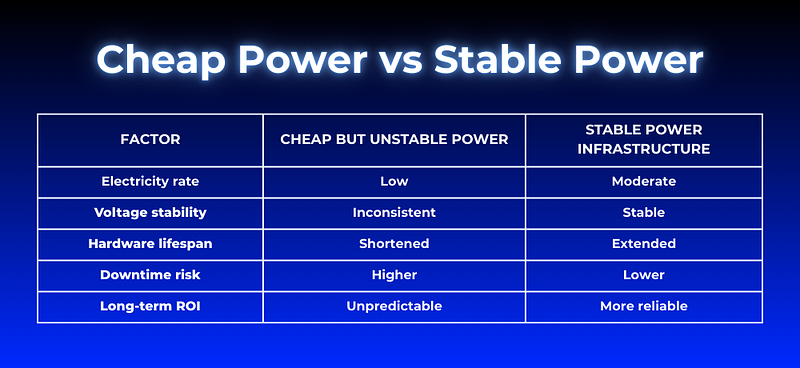
Low rates mean little if downtime and hardware replacement erase savings.
The Hidden Cost of Poor Power Quality
Miners often focus only on electricity rate calculations:
Daily kWh × $/kWh
But they ignore hidden costs such as:
- PSU replacement
- Hashboard repairs
- Reduced efficiency over time
- Unexpected downtime
- Lost revenue from instability
When power quality is poor, the real cost of electricity becomes much higher than the advertised rate.
Why Voltage Stability Protects ROI
Stable power delivery provides:
- Consistent frequency operation
- Lower electrical stress
- Reduced thermal fluctuation
- Predictable hashrate output
Over years of operation, stability compounds into:
- Fewer failures
- Longer hardware lifespan
- Better sustained profitability
In long-term mining, durability beats discount pricing.
How IceRiver Approaches Power Infrastructure
IceRiver miners are engineered with stable power delivery systems designed for continuous operation.
In professional hosting environments, this is reinforced through:
- Industrial-grade power infrastructure
- Voltage regulation systems
- Proper circuit load balancing
- Surge protection
- Continuous monitoring
👉 Learn about IceRiver hosting environments:
https://www.iceriver.app/pages/hosting
When miner design and stable infrastructure align, hardware longevity improves significantly.
Real-World Insight: Why “Cheap Regions” Aren’t Always Better
Some regions advertise extremely low electricity prices.
But if infrastructure is unstable, miners may face:
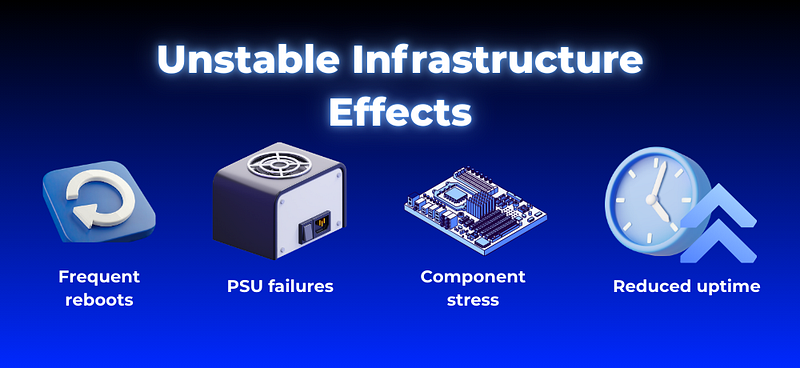
A slightly higher electricity rate with stable voltage often results in better long-term ROI.
Mining is a multi-year operation — not a short-term electricity arbitrage.
Engineering Over Discounts
True efficiency is not only about watts per TH.
It also includes:
- Clean power delivery
- Voltage consistency
- Thermal stability
- Environmental control
At IceRiver, infrastructure decisions are made to protect hardware first — because damaged hardware erases cheap electricity savings quickly.
Conclusion
Electricity cost matters.
But electricity quality matters more.
Cheap power that damages hardware is not a bargain — it is a liability.
Stable voltage, clean delivery, and proper infrastructure protect uptime, hardware lifespan, and predictable ROI.
At IceRiver, mining stability begins with engineering — not just electricity pricing.
🔗 Stay Connected
📱 Instagram
📘 Facebook
🎥 YouTube
📱 TikTok
📢 Twitter