

When miners calculate profitability, they usually focus on:
- Electricity cost
- Hardware price
- Daily revenue
- Break-even timeline
But one critical cost is often ignored:
Downtime.
At IceRiver, uptime is treated as a profitability factor — not just a technical metric. Because even small interruptions compound over time, and hidden profit loss can quietly erase margins.
Let’s break down why downtime is the most underestimated cost in mining.
Downtime Is Not Just “Offline Time”
Most miners think downtime only means a miner completely shutting off.
In reality, downtime includes:
- Full shutdowns
- Thermal throttling
- Power instability restarts
- Network disconnections
- Underperformance due to overheating
Even partial performance drops reduce real earnings.
The Simple Math of Downtime
Assume your miner earns:
- $25 per day
That equals:
$25 ÷ 24 ≈ $1.04 per hour
Now imagine:
- 3 hours of downtime per week
Weekly loss:
$1.04 × 3 = $3.12
Monthly loss:
$3.12 × 4 ≈ $12.48
Annual loss:
$12.48 × 12 ≈ $149.76
And that’s only 3 hours per week.
Small interruptions compound fast.
What If Downtime Is Worse?
Let’s assume:
- $30/day miner
- 1 full day offline per month
Monthly loss:
$30 × 1 = $30
Annual loss:
$30 × 12 = $360
That’s the equivalent of several months of electricity.
Now imagine multiple units.
Downtime scales with fleet size.
Downtime vs Electricity Cost
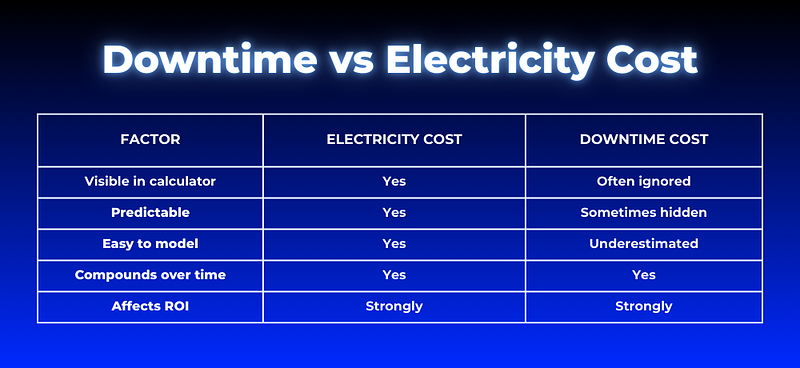
Electricity cost is visible.
Downtime cost is silent.
What Causes Downtime in Real Mining?
Common causes include:
- Heat fluctuation
- Dust buildup
- Voltage instability
- Network outages
- Poor rack spacing
- Delayed response to alerts
Many of these issues are environmental — not hardware defects.
Why Small Interruptions Matter
Mining is continuous.
Revenue accumulates 24/7.
Every interruption pauses income — but expenses continue.
- Electricity contracts remain
- Hosting fees continue
- Capital cost remains locked
Downtime increases effective cost per TH.
The Compound Effect on ROI
If your break-even target is 250 days and downtime reduces earnings by 10%, your new break-even becomes:
250 ÷ 0.90 ≈ 278 days
That’s nearly one extra month of capital exposure.
Over multiple market cycles, this compounds.
Why Uptime Infrastructure Matters
At IceRiver, hosting environments prioritize:
- Stable voltage infrastructure
- Managed airflow and cooling
- Dust-controlled facilities
- 24/7 monitoring
- Rapid response procedures
👉 Learn more about IceRiver hosting:
https://www.iceriver.app/pages/hosting
Stable environments reduce the slow performance degradation that leads to frequent downtime.
Home Setup vs Professional Hosting

Reducing downtime is often more valuable than chasing slightly cheaper electricity.
The Hidden Truth
Cheap power does not compensate for unstable uptime.
A miner earning slightly less per day but running consistently will outperform a higher-earning miner that experiences frequent interruptions.
In long-term mining:
Consistency beats spikes.
Conclusions
Downtime is the most overlooked mining cost because it’s not always obvious.
Even small interruptions:
- Reduce annual profit
- Extend break-even timelines
- Increase capital risk
- Compound over time
Mining profitability isn’t just about hardware and electricity — it’s about sustained uptime.
At IceRiver, stability is treated as an engineering priority, because predictable performance protects long-term ROI.
🔗 Stay Connected
📱 Instagram
📘 Facebook
🎥 YouTube
📱 TikTok
📢 Twitter