

When a miner’s hashrate suddenly dips, many assume something is wrong with the hardware.
In reality, most hashrate drops are not random — they are environmental.
At IceRiver, real-world mining performance is understood as a system: hardware, airflow, power stability, and operating conditions working together. When one of those variables shifts, performance follows.
Let’s break down the most common environmental causes of hashrate drops — and how to prevent them.
1. Heat Fluctuation and Thermal Throttling
Heat is the most common cause of performance instability.
ASIC miners are designed to protect themselves. When internal temperatures exceed safe thresholds, the firmware reduces frequency automatically to prevent damage. This process is called thermal throttling.
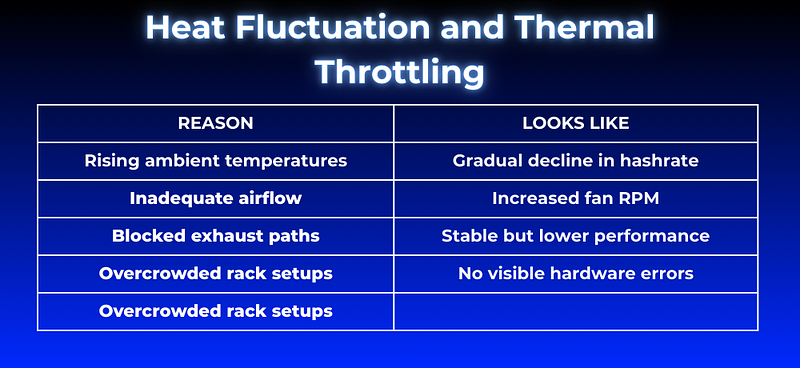
Even small increases in operating temperature can trigger slight frequency reductions.
The miner isn’t failing — it’s protecting itself.
2. Dust and Airflow Restriction
Dust buildup is one of the most overlooked causes of performance drops.
Over time, dust:
- Restricts intake airflow
- Traps heat around hashboards
- Forces fans to spin faster
- Reduces cooling efficiency
Airflow efficiency decreases gradually, which slowly increases internal temperatures.
The result: throttling.
This is why controlled environments matter.
👉 Explore IceRiver miners engineered for optimized airflow:
https://www.iceriver.app/collections/iceriver-miners
3. Unstable Power Delivery
Hashrate consistency depends on stable voltage.
Power instability can be caused by:
- Inconsistent grid supply
- Undersized wiring
- Overloaded circuits
- Poor-quality PSUs
- Voltage fluctuation
When voltage fluctuates, miners may:
- Lower frequency
- Restart hashboards
- Show inconsistent performance
Even small voltage dips can impact sustained hashrate.
Professional infrastructure reduces these risks significantly.
👉 Learn about IceRiver hosting environments:
https://www.iceriver.app/pages/hosting
4. Ambient Environment Changes
Mining environments evolve over time.
Common changes include:
- Adding more machines to the same room
- Seasonal temperature increases
- Poor ventilation adjustments
- Layout changes that block airflow
What worked perfectly at installation may degrade slowly without being noticed.
This is why consistent monitoring is critical.
Environmental Causes of Hashrate Drops
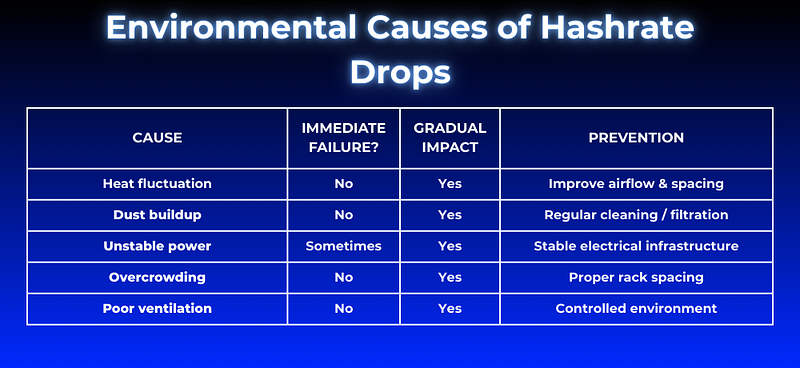
Most hashrate drops fall into the gradual impact category.
5. Why Performance Drops Feel “Random”
Hashrate drops feel unpredictable because:
- Environmental shifts are subtle
- Temperature drift is slow
- Power fluctuations aren’t visible
- Dust accumulates gradually
By the time performance visibly changes, the cause has been building for weeks.
That’s why prevention matters more than reaction.
How IceRiver Minimizes Environmental Impact
IceRiver miners are designed with:
- Directed airflow channels
- Balanced internal layouts
- Stable power delivery systems
- Continuous-operation engineering
When combined with professional hosting:
- Ambient temperature is managed
- Airflow is controlled
- Power is stabilized
- Dust exposure is reduced
This significantly reduces gradual performance degradation.
Real-World Insight: Performance Is a System
Hashrate is not just a hardware number.
It reflects:
- Thermal stability
- Electrical stability
- Environmental consistency
When those systems are stable, performance remains stable.
When they shift, performance follows.
Conclusion
Most hashrate drops aren’t hardware defects.
They are environmental.
Heat fluctuation, dust accumulation, and unstable power delivery account for the majority of real-world performance instability.
Understanding this allows miners to:
- Improve uptime
- Protect hardware lifespan
- Maintain predictable ROI
At IceRiver, miner design and hosting infrastructure are built around environmental stability — because sustained performance always depends on conditions, not just specifications.
🔗 Stay Connected
📱 Instagram
📘 Facebook
🎥 YouTube
📱 TikTok
📢 Twitter