

Most mining hardware failures are not caused by defective machines. In real-world operations, the majority of problems come from environmental conditions around the miner.
Dust buildup, unstable temperatures, and poor airflow slowly damage internal components over time. Fans wear out faster, ASIC chips begin to throttle, and power supplies operate outside optimal ranges. The result is reduced hashrate, unexpected downtime, and a shortened hardware lifespan.
Experienced operators understand that environment management is just as important as the miner itself. A well-controlled setup can keep machines running efficiently for years, while a poorly managed environment can destroy expensive hardware in a matter of months.
In this guide, we break down the three biggest miner killers and provide practical checklists miners can follow to prevent issues before they happen.
The Three Biggest Miner Killers (Quick Overview)
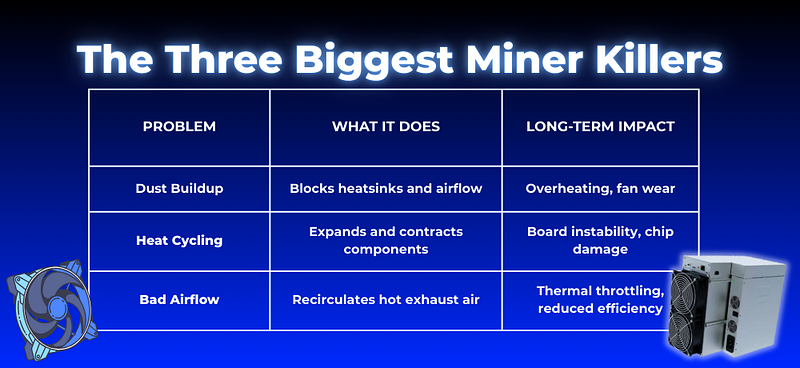
These three factors account for a large percentage of support issues miners experience.
1. Dust: The Silent Performance Killer
Dust is one of the most common issues affecting mining hardware. Because ASIC miners move large volumes of air every minute, they naturally pull in dust particles from the surrounding environment.
Over time, dust accumulates inside the miner, especially on heatsinks and cooling fans.
Why Dust Is Dangerous
Dust buildup causes several problems:
- Reduced airflow across heatsinks
- Higher chip temperatures
- Increased fan workload
- Reduced cooling efficiency
- Potential electrical shorts in extreme cases
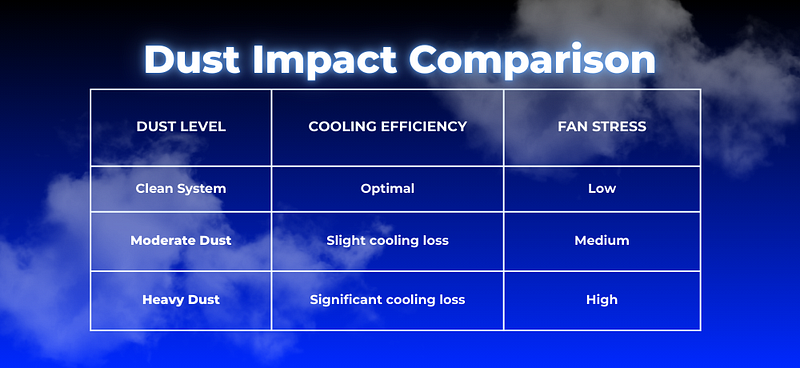
When dust blocks airflow, heat becomes trapped around the ASIC chips. This causes temperatures to rise, forcing fans to work harder while performance gradually declines.
Dust Impact Comparison
Signs Your Miner Needs Cleaning
Look for these early warning indicators:
- Increasing chip temperatures
- Fans running near maximum speed
- Declining hashrate performance
- Visible dust accumulation on intake vents
Dust Prevention Checklist
Operators should regularly:
- Clean miners every 2–4 weeks
- Use compressed air to remove dust from heatsinks
- Install intake air filters
- Keep mining rooms sealed and clean
Small maintenance routines can significantly extend the lifespan of mining hardware.
2. Heat Cycling: The Hidden Stress on ASIC Chips
While overheating gets most of the attention, temperature fluctuation is another major threat to mining hardware.
Heat cycling occurs when miners repeatedly heat up and cool down. This commonly happens when machines are frequently powered on and off or when environmental temperatures fluctuate significantly.
Why Heat Cycling Causes Damage
ASIC chips expand when heated and contract when cooled. Over time, repeated expansion and contraction create mechanical stress on the internal connections.
This stress can damage:
- solder joints
- chip packaging
- control board connections
Eventually, these micro-stresses may lead to instability or hardware failure.
Temperature Stability Comparison

Large mining farms avoid this issue by maintaining consistent operating temperatures 24/7. Monitoring fan speeds and chip temperatures is an important early warning system for miners. This is explained in detail in the IceRiver EU fan speed and temperature guide.
Common Causes of Heat Cycling
Typical causes include:
- frequently turning miners on and off
- unstable room temperatures
- inconsistent cooling systems
- day and night temperature swings
Prevention Checklist
To reduce heat cycling:
- avoid frequent power cycling
- maintain consistent room temperatures
- run miners continuously when possible
- monitor chip temperature fluctuations
Consistency is key. ASIC hardware performs best when temperatures remain stable.
3. Bad Airflow: The Most Overlooked Problem
Many miners assume placing a machine in a cool room is enough. In reality, airflow direction is often more important than ambient temperature.
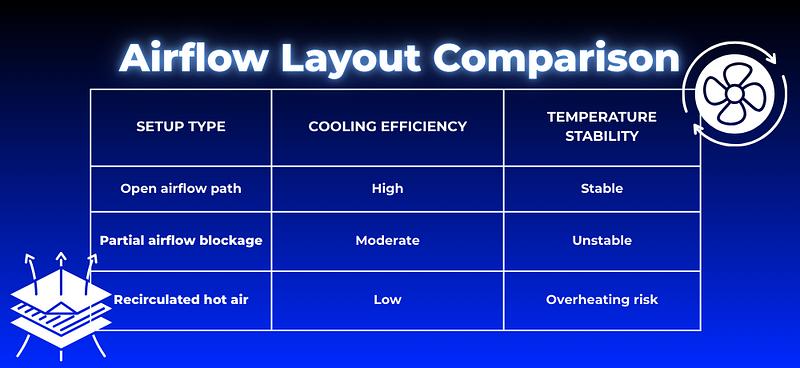
ASIC miners rely on a continuous airflow path from front intake to rear exhaust. If hot air is trapped or recirculated, cooling efficiency drops dramatically.
Common Airflow Mistakes
Typical mistakes include:
- placing miners too close together
- blocking exhaust airflow
- circulating hot air back toward the intake
- running miners inside enclosed spaces
Even if the room temperature feels cool, poor airflow can cause internal temperatures to rise quickly.
Airflow Layout Comparison
Airflow Prevention Checklist
To maintain proper airflow:
- allow 30–50 cm clearance behind miners
- separate intake and exhaust air paths
- ensure constant air movement in the room
- avoid enclosed cabinets without ventilation
Professional mining facilities often use cold aisle and hot aisle airflow layouts to manage heat effectively.
Environmental Impact on Mining Performance
Environmental conditions directly affect mining performance and hardware lifespan.

This is why experienced miners invest heavily in infrastructure rather than focusing only on hardware.
Daily Miner Health Checklist
Professional operators follow simple daily monitoring routines to catch problems early.
A basic daily check should include:
✔ Monitor chip temperatures
✔ Check fan speed behavior
✔ Ensure airflow paths are clear
✔ Look for unusual noise or vibration
✔ Confirm stable hashrate output
These quick checks often prevent major hardware failures.
Why Infrastructure Matters More Than Hardware
New miners often focus entirely on purchasing the latest or most powerful ASIC machines.
However, experienced operators understand that infrastructure determines long-term performance.
A properly managed environment provides:
- stable temperatures
- clean airflow
- minimal dust buildup
- consistent uptime
These conditions allow miners to operate efficiently for extended periods.
For miners who prefer a professionally managed setup, infrastructure-focused hosting environments remove many of these risks entirely.
Facilities such as IceRiver EU hosting centers are designed with controlled airflow systems, professional cooling infrastructure, and stable operating environments to ensure consistent mining performance.
Conclusion
Dust, heat cycling, and poor airflow are responsible for a large percentage of mining hardware failures.
The good news is that these problems are entirely preventable with simple operational practices.
Maintaining clean equipment, stable temperatures, and proper airflow will dramatically extend the lifespan of mining hardware while improving mining efficiency and uptime.
Mining success does not depend only on powerful hardware. It depends on the environment where that hardware operates.
Miners who focus on infrastructure and maintenance will always outperform those who ignore it.
You can explore more mining infrastructure guides in the IceRiver EU blog.