

Buying an ASIC miner is not just about profitability. It’s also about whether your space and electrical setup can realistically support it.
Many new miners focus only on hashrate and price — and ignore circuit limits, ventilation, heat output, and noise levels. The result? Overloaded breakers, overheating rooms, or unstable performance.
At IceRiver EU, proper miner sizing is treated as a foundational step — because hardware only performs well when the environment supports it.
Let’s break down how to choose a miner that actually fits your space and power.
1️⃣ Understand Your Circuit Limits First
Before choosing any miner, ask:
- What amperage is your circuit rated for?
- Is it 110–120V or 220–240V?
- Is the circuit dedicated, or shared with other devices?
Basic Electrical Rule
Maximum Safe Load ≈ 80% of Circuit Capacity
Example:
- 20A circuit at 120V
- Maximum continuous safe load ≈ 16A
If a miner draws 3,200W:
3,200W ÷ 120V ≈ 26.7A
That exceeds the safe limit of a 20A breaker.
This is one of the most common buyer mistakes.
Circuit Capacity Comparison
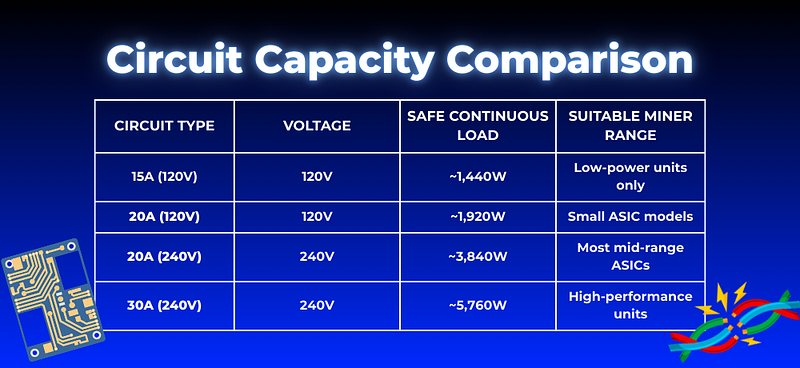
Choosing a miner without matching circuit capacity risks shutdowns and long-term electrical stress.
2️⃣ Ventilation Space Is Not Optional
ASIC miners generate constant heat.
A 3,500W miner produces heat equivalent to running multiple space heaters continuously.
Without proper ventilation:
- Room temperature rises
- Internal miner temperature increases
- Hashrate may throttle
- Hardware lifespan shortens
Basic Space Planning Rule
Ensure:
- Clear intake airflow
- Unblocked exhaust
- Adequate room ventilation
- Minimum 20–30 cm spacing around the unit
Heat Output Comparison
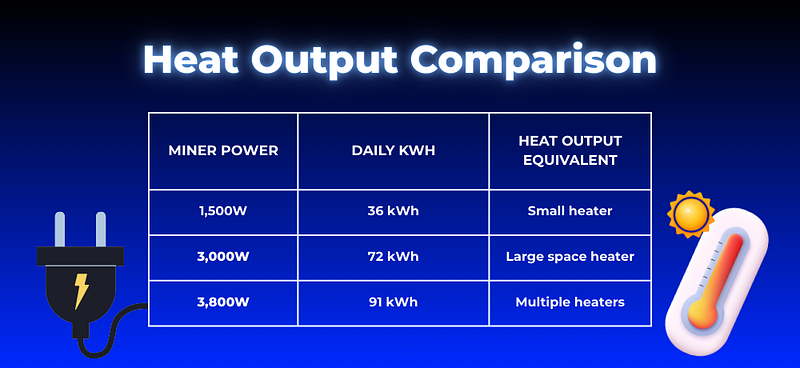
Heat planning is part of miner sizing.
3️⃣ Noise Planning: The Hidden Factor
Most ASIC miners operate between:
- 70–80 dB
That’s comparable to:
- Vacuum cleaner
- Busy traffic
- Industrial equipment
In residential settings, this becomes disruptive quickly.
Questions to consider:
- Is your mining space isolated?
- Will noise affect neighbors?
- Is soundproofing installed?
Improper noise planning leads many home miners to shut down units prematurely.
4️⃣ Power + Space + Noise = Total Fit
A miner may be profitable on paper — but completely unsuitable for your physical setup.
Sizing checklist before buying:
- ✔ Circuit capacity confirmed
- ✔ Voltage verified
- ✔ Ventilation path planned
- ✔ Noise expectations realistic
- ✔ Room heat load evaluated
Skipping these steps leads to downtime and hardware stress.
5️⃣ When Hosting Makes More Sense
If your space cannot support:
- High wattage
- Stable voltage
- Proper airflow
- Noise isolation
Professional hosting may be more suitable.
👉 Explore IceRiver EU hosting options:
https://www.iceriver.eu/pages/hosting
Hosting environments are built for:
- Industrial-grade circuits
- Controlled airflow
- Stable voltage
- 24/7 monitoring
Sometimes the right sizing decision is not choosing a smaller miner — but choosing the right environment.
6️⃣ Common Miner Sizing Mistakes
- Buying based only on hashrate
- Ignoring voltage compatibility
- Underestimating heat buildup
- Overloading residential circuits
- Failing to plan airflow
Miner sizing is about system compatibility — not just hardware.
Conclusion
Miner sizing is not optional. It is part of mining strategy.
Choosing a miner that fits your space and power:
- Reduces downtime
- Prevents breaker trips
- Protects hardware lifespan
- Improves long-term ROI
At IceRiver EU, miner performance is treated as a partnership between hardware design and environment planning.
The right miner is not just the most powerful one.
It’s the one your setup can sustain.